Robert Johnson
Lords of ChaosRobert Johnson is portrayed as a pivotal Blues musician whose legend links the music’s spiritual imagery to the later lineage of Satanic rock and Black Metal. The account holds two things together: the concrete record of a short career and twenty-nine recorded tunes, and the enduring story that he gained his extraordinary playing ability through a pact with Satan at a crossroads in the Mississippi Delta.
Music and the Crossroads Legend
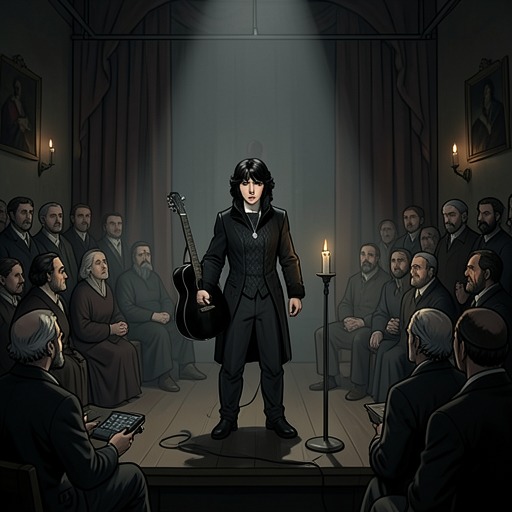
Blues, the book argues, was more directly associated with deviltry than Jazz and carried the force of its racial origins. Enslaved Black people in America often adopted Christianity while blending it with native or Voudoun traditions; Blues songs, in turn, made frequent reference to devils, demons, and spirits. Johnson’s music belongs to this tradition, while the story of his pact with Satan gives that spiritual language a personal legend: it is said that he sold his soul at a crossroads and was rewarded with the ability to play.
Johnson recorded only twenty-nine tunes. Among the best known are Crossroads Blues, Me and the Devil Blues, and Hellhound on My Trail. The book hears resignation in his music and connects it to the difficult course of his life, without treating the crossroads story as established fact.
Life and Posthumous Reception
Johnson’s life began on plantations and continued through years of carousing and playing in juke joints. It ended abruptly in 1938, when he was twenty-seven: he was poisoned in a bar, probably because of an affair with the club owner’s wife. The account gives that cause cautiously, as a probability rather than a settled explanation.
After his death, his musical legacy faded into obscurity. Reissues on LPs in the 1960s brought the recordings to an excited new audience among Blues Rock musicians, restoring attention to a body of work that had remained little known.
A Musical Lineage
The book places Johnson at the distant end of a lineage that runs through The Rolling Stones, Led Zeppelin, Black Sabbath, Mercyful Fate, and Venom to Black Metal. It presents this as an unlikely ancestry, not as a claim that Johnson belonged to later metal scenes: his place in the chain comes from the Blues traditions and demonic musical imagery that later artists transformed. In that account, the crossroads legend becomes one strand in a broader cultural inheritance, carried forward by successive musicians and reshaped as the sound and themes of Black Metal developed.